


From September 18 to 26, 2026, Donostia hosts the 74th San Sebastián International Film Festival. Nine days, seventeen films in competition, and a guest list that includes Ricardo Darín, Naomi Watts, Penélope Cruz, Jeremy Irons, Werner Herzog, and, for the first time since 2009, Brad Pitt. Here are the dates, who's coming, what's up for grabs, what the different sections mean, and how to get tickets.

Naomi Watts, Premio Donostia 2026
If you've followed the festival before, you know the names change every year but the rhythm doesn't: screenings from early morning, galas as the evening sets in, and a whole city keeping an eye on what premieres at the Kursaal. This edition comes with an extra layer of significance: it's the last one directed by José Luis Rebordinos before a generational handover.
When is the San Sebastián Film Festival 2026
The festival opens Friday, September 18, and closes Saturday, September 26. That's nine days of screenings spread across several venues in the city, with the opening and closing galas drawing the most attention.
This is the 74th edition of a festival founded in 1953 that has held FIAPF Category A status since then, the same category as Cannes, Venice, or Berlin. In practice, that means San Sebastián can host world premieres on equal footing with those three festivals, a distinction shared by only fourteen film festivals worldwide.
It's also an edition marking the end of an era: it will be the last led by José Luis Rebordinos, who steps down after two decades running the festival. Maialen Beloki, appointed in April 2026, takes over the role in January 2027. If you want the full story of how the festival has evolved since it was founded and why it's spread across so many buildings, we cover it in 5 fun facts about the San Sebastián Film Festival.
Who's coming to the 74th edition
Let's start with the news that had more than one Amara neighbor doing a double take on the festival lineup: Brad Pitt is coming back to San Sebastián. The festival announced it on August 24, 2026: Pitt will present Heart of the Beast, a Paramount thriller directed by David Ayer in which he plays a retired Special Forces officer who survives a plane crash in Alaska alongside his combat dog. He's joined in the cast by J.K. Simmons and Anna Lambe, and Pitt himself produces the film with Olivia Hamilton, Marty Bowen, and Ayer, with Damien Chazelle on board as executive producer.
The film screens out of competition, but its addition completes the full Official Selection lineup: seventeen titles competing, three out of competition, and five Special Screenings. Pitt's last visit to Donostia was in 2009, when he presented Inglourious Basterds alongside Quentin Tarantino in the Perlak section. Seventeen years later, he's trading Tarantino's Nazis for Alaska's bears. Ayer, for what it's worth, has been here before with similar material: he wrote the screenplays for U-571 and Training Day before directing Fury and End of Watch himself, so he knows his way around putting an actor in uniform and a life-or-death situation.
This year's Donostia Awards go to two names whose careers are nearly impossible to sum up in one line. Naomi Watts will receive hers on Saturday, September 19, at the same gala where she'll present The Housewife, the directorial debut of Canadian filmmaker Ben Shirinian; actress Lena Olin will join her in Donostia, and filmmaker J.A. Bayona will be the one handing her the award. Werner Herzog will receive his at the opening gala, alongside a screening of his latest feature, Bucking Fastard, which will go on to compete at the Venice Film Festival; in his case, it'll be actor Orlando Bloom, who stars in the film, presenting him with the award. Herzog has spent six decades making films about people up against environments that refuse to cooperate, so watching Brad Pitt battle the Alaskan wilderness in the same edition has its own accidental irony.
The Official Selection also picked up new titles in the running for the Golden Shell, with films from Jesse Eisenberg (The Debut, his third feature as a director), Fred Cavayé (Les Misérables, starring Vincent Lindon, Tahar Rahim, Noémie Merlant, Camille Cottin, and Benjamin Lavernhe), and Amanda Kernell (Brace Your Heart). Three very different filmmakers, which gives a sense of where this year's competition is headed: no single type of film dominates the lineup.
On September 4, the organizers announced the full lineup for this edition: 263 titles from 47 countries. Names joining the guest list include Marion Cotillard, Penélope Cruz, Jeremy Irons, Vincent Lindon, Rami Malek, Diego Luna, Denis Lavant, and Tom Sturridge. The Official Selection jury will be chaired by filmmaker Ira Sachs, alongside director Genki Kawamura, screenwriter Catherine Paillé, actresses Alice Braga and Patricia López Arnaiz, actor Bill Skarsgård, and producer Mike Goodridge.
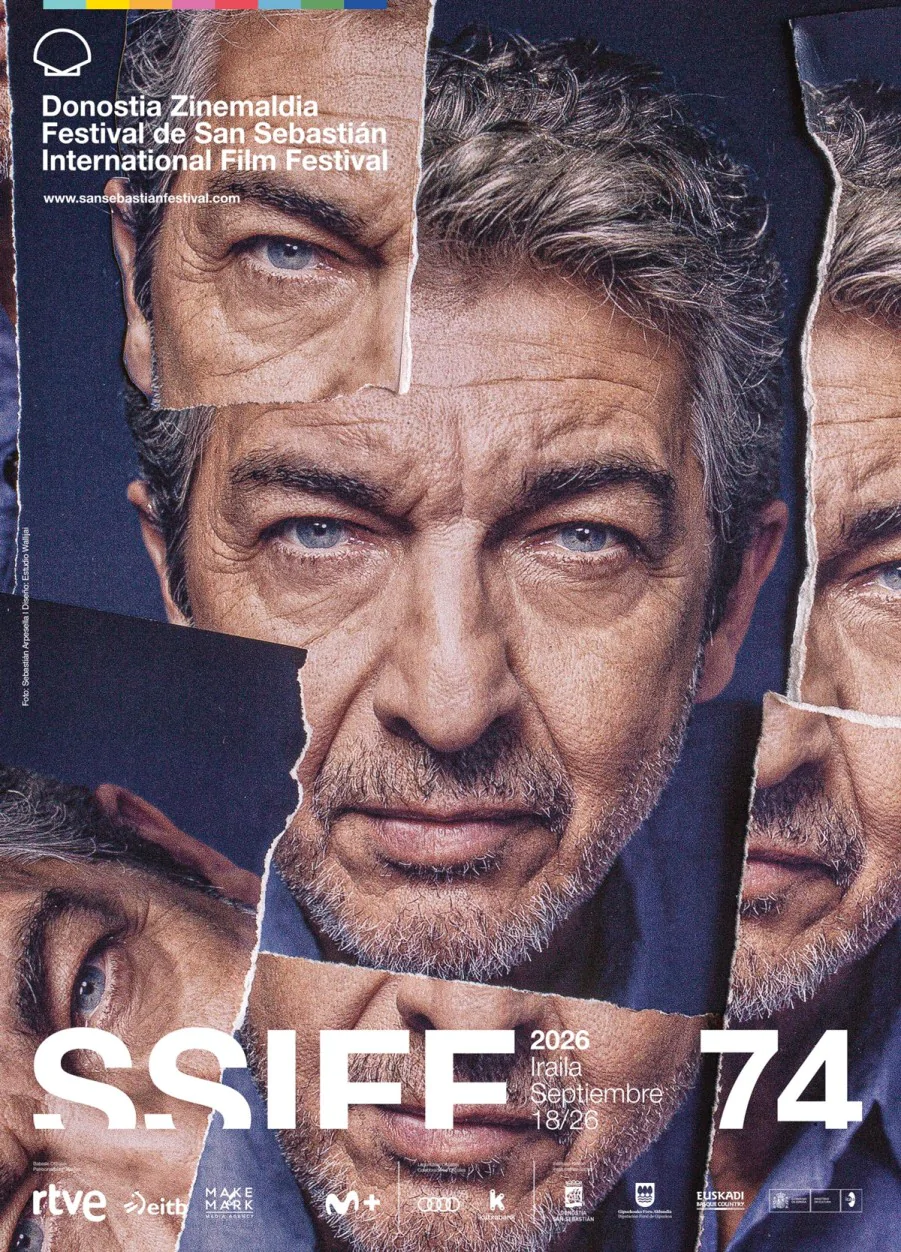
This year's poster
This year's poster
The 2026 poster is fronted by Ricardo Darín, the Argentine actor, producer, and director who received his own Donostia Award back in 2017. It was unveiled on June 3 at Tabakalera, at an event where outgoing director Rebordinos and incoming director Beloki appeared together, giving the poster added weight as a transition-year image.
Darín is also a familiar face here: he's been showing up in San Sebastián regularly for twenty years now. Having him front a changing-of-the-guard edition makes sense. He's one of the few faces who's seen enough festival directors come and go to serve as a throughline. This year, he's not just the poster face, either: he's coming to Donostia to present Lo dejamos acá, a film by Hernán Goldfrid, screening as part of the festival's Other Activities program.
The retrospective: José Giovanni, godfather of the French polar
Every year, the festival dedicates a full retrospective to a figure in film history. In 2026, that honor goes to José Giovanni (1923–2004), born in Paris as Joseph Antoine Roger Damiani, a screenwriter, director, and one of the most recognized voices of the polar, the French equivalent of American film noir.
His own life explains a lot of his work. Sentenced to death for a crime committed in his youth (a sentence later commuted), he wrote about his time in prison in the novel La evasión (1958). Jacques Becker adapted it for the screen as Le Trou (1960), with Giovanni co-writing the screenplay. From there, he worked as a screenwriter or adapter for names like Jean-Pierre Melville, Jacques Deray, Claude Sautet, Henri Verneuil, and Robert Enrico, before directing about fifteen films of his own.
The retrospective, organized with the Basque Filmoteca and the Spanish Filmoteca, will bring together twenty feature films released between 1960 and 2001: nearly his entire output as a director, plus eight titles he wrote for other filmmakers. The program is rounded out by the publication of José Giovanni. No hay vida plena sin piedad, a book by Felipe Cabrerizo, edited by Quim Casas, that also digs into the more controversial episodes of his biography. Since 2024, this retrospective has been part of the festival's Klasikoak program, which also includes classic film screenings during the festival and a follow-up series of restored films shown across the Basque Country and Navarre.
What's up for grabs
The top prize is the Golden Shell, awarded to the best film in the Official Selection. Alongside it, the festival hands out Silver Shells for best director, best actor, and best actress, the Kutxabank-New Directors Award, and the Horizontes Award, plus other prizes tied to specific sections.
Then there's the Donostia Award, the honorary lifetime achievement prize that goes to Watts and Herzog this year. It isn't voted on; the festival's organizers decide it as a tribute, usually for figures who left their mark on cinema long before ever stepping onto a stage at the Kursaal to accept it.
To get a sense of what tends to win, last year's Golden Shell went to Sundays, by Spanish director Alauda Ruiz de Azúa, while the Special Jury Prize went to Good Valley Stories, by filmmaker José Luis Guerin. Two very different films, which confirms something that holds true year after year: the jury doesn't have a fixed preference for one country or style.
The sections, explained
The festival's program is organized into sections, and they're not all competing for the same thing. If this is your first time following along, here's a quick guide: Official Selection is the main competition, the one competing for the Golden Shell. New Directors highlights first or second features from emerging filmmakers. Horizontes Latinos is a tribute to films made in Latin America. Zabaltegi-Tabakalera brings together a more open, experimental selection of international cinema. Perlak rounds up the best of the year's festival circuit, films that have already played elsewhere but haven't yet been seen in Spain, which is how Inglourious Basterds ended up here in 2009. Culinary Zinema pairs screenings with themed dinners built around food. Made in Spain and Zinemira are dedicated to Spanish and Basque productions respectively. Klasikoak screens restored classic films, and Nest focuses on work from film schools. The Velódromo Antonio Elorza hosts the big open-air public screenings, including world premieres like Karateka and a concert-and-screening event organized with the Euskadiko Orkestra and the SGAE Foundation.
Where the festival takes place
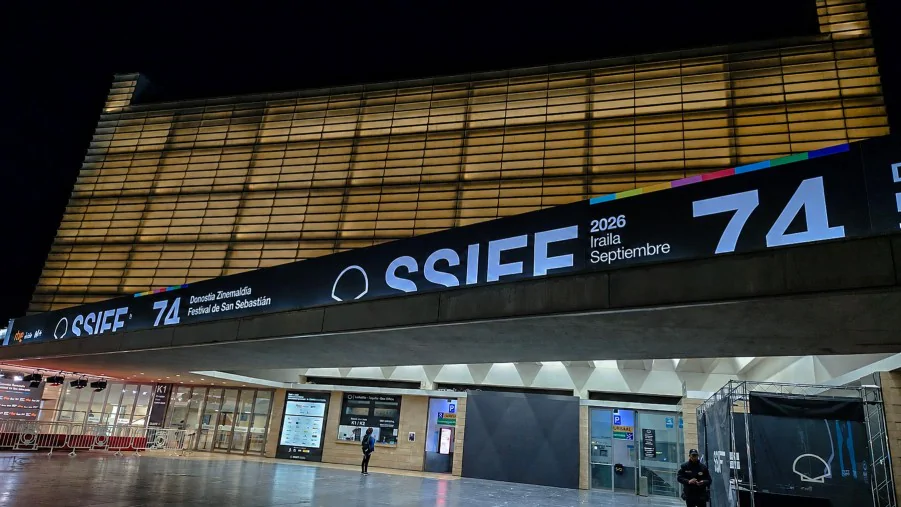
Screenings are spread across Tabakalera, the Victoria Eugenia Theatre, the Teatro Principal, the Príncipe and Antiguo Berri cinemas, and the Velódromo Antonio Elorza. The Kursaal Congress Centre and Auditorium remains the festival's hub: it's where the opening and closing galas take place, along with most Official Selection screenings.
For more on why the festival uses so many different buildings and how long the Kursaal has played this role, we go into more detail in 5 fun facts about the San Sebastián Film Festival.
How to get tickets
The full program for this edition goes live on the festival's website and in local media on Monday, September 7. Before that, from September 9 to 11, you can buy the Película a Película guide for €2.50 at the festival office, on the second floor of Tabakalera, from 10:00 a.m. to 2:00 p.m. and 3:30 to 7:00 p.m. Starting Saturday, September 12, the guide is also available at the festival's information point at the Kursaal, open from 9:00 a.m. to 8:00 p.m. between September 12 and 17, and from 8:30 a.m. to 10:00 p.m. during the festival itself, September 18 through 26.
General ticket sales open on Sunday, September 13, at 9:00 a.m., staggered across three days depending on which screening you want: on the 13th, tickets go on sale for Friday the 18th, Saturday the 19th, and Sunday the 20th; on the 14th, for Monday the 21st, Tuesday the 22nd, and Wednesday the 23rd, plus any tickets left over from the earlier days; and on the 15th, for Thursday the 24th, Friday the 25th, and Saturday the 26th, along with any remaining sessions. Season passes for this edition are already sold out, so individual tickets per screening are the only option left.
Every online or box-office ticket carries a €0.65 handling fee. Buying ten or more tickets in a single purchase gets you a 25% discount on screenings priced at €8.75. Tickets are sold through the festival's official website, where you can also check the full program by day and by section before deciding what to see.
A different kind of week in Donostia
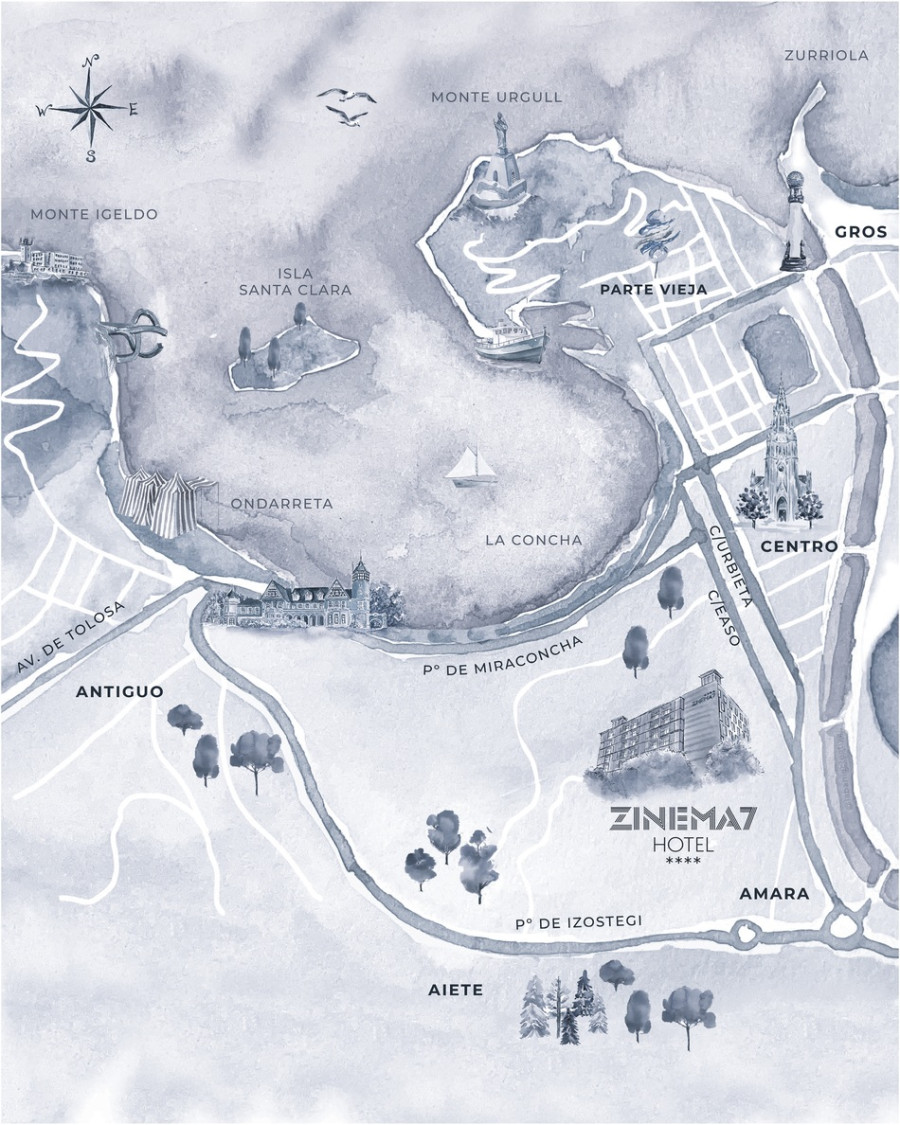
For these nine days, San Sebastián runs on a different rhythm than the rest of the year: there are lines outside the Kursaal at hours when the only crowds are usually on the beach, and conversations at bars in Amara and the Antiguo neighborhood shift topic for the whole week. If you're coming for a screening or just want to take in the atmosphere, at Zinema7 Hotel cinema is in our name for more than aesthetics: we're part of Sade, the Donostia-based company with a century-long connection to the city's cinemas. You don't have to be a film buff to stay with us, but if you are, you'll understand better than most why this particular week in September feels different.
And if you're wondering what a movie character would do staying in Donostia this week, the answer is probably simple: come down for breakfast, leave the shooting script in the room, and walk to the Kursaal without rushing, the way someone does when they know the best scene of the week hasn't been shot yet. You don't have to be Ricardo Darín to get that logic.
Discover Zinema7 Hotel and book your stay for this year's festival.
Zinema 7 Hotel

20010 Donostia - San Sebastián (Guipúzcoa) info@zinema7hotel.com T. +34 943 445 000


